
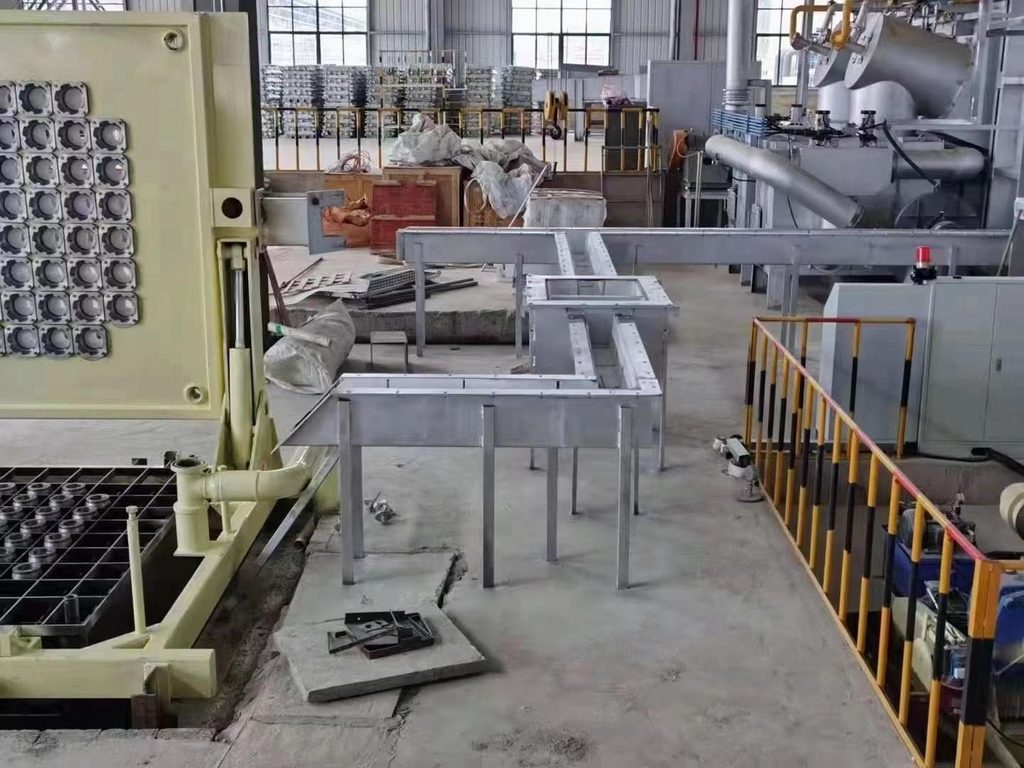
Pick up an aluminum window frame, a forged truck wheel, or the crash structure hidden inside a car door. Months before any of those parts existed, their metal was a glowing column dropping out of a casting mold. In a growing share of casthouses around the world, that mold belonged to a hot top billet casting machine. Follow the billet from the cast floor to its final job, and you start to see why a hot top billet casting machine has become the default choice wherever the end product refuses to tolerate flaws.
The scale is easy to underestimate. A single mid-size casthouse can pour tens of thousands of tonnes of billet a year, and nearly every tonne is already spoken for before it cools — allocated to extruders, forgers, and remelters working to tight delivery schedules. When that much metal flows through one building, the casting technology at the front of the line sets the quality ceiling for everything downstream.
Extrusion: The Biggest Appetite for Clean Billets
The extrusion press is the hungriest customer. It takes a heated billet and squeezes it through a die into profiles — window frames, curtain walling, heat sinks, railings, structural sections. Extrusion is unforgiving: any defect riding on the billet surface prints straight onto the profile as a streak, tear, or pick-up mark. Press operators can tell within minutes whether the billet came from a hot top billet casting machine, because the surface behaves instead of fighting them. That is why extruders were among the first buyers to insist on billets from a hot top billet casting machine — fewer press stops, less scrap, and profiles that anodize evenly without ugly surprises.
The popular 6xxx-series extrusion alloys — 6063 for architectural profiles, 6061 for structural parts — are particularly sensitive to surface condition, because anodizing magnifies every imperfection into a visible streak. An extruder running architectural profiles cannot afford that: a batch of streaked curtain-wall sections is a rejected truckload. Clean as-cast skin means thinner scalping, and thinner scalping means more of each billet survives as finished profile.
Forging Stock: Where Hidden Flaws Get Punished
Forging is less forgiving still. A billet gets sliced into slugs, heated, and hammered or pressed into shape — wheels, suspension arms, steering knuckles, truck hubs. Deformation magnifies whatever was hiding inside the metal: a pore becomes a crack, an inclusion becomes a rejection. Forging stock from a hot top billet casting machine starts life with a sounder interior, which is why forgers pay a premium for billets cast on a hot top billet casting machine rather than gambling on cheaper metal that might split under the press.
Forged aluminum road wheels are the classic example. Each wheel starts as a slice of billet, gets preformed, then takes its final shape under thousands of tonnes of force. A wheel with an internal flaw is not just scrap — it is a safety liability rolling down a highway. Forgers learned long ago that the cheapest place to guarantee wheel integrity is at the casting stage, long before the forging press ever closes.
Automotive Parts You Never See
Open up a modern car and the aluminum is everywhere you are not looking: crash boxes, subframes, bumper beams, EV battery trays, structural nodes joining body panels. Most of these begin as extruded or forged parts, and most of those begin as billets from a hot top billet casting machine. Carmakers audit their metal suppliers ruthlessly — chemistry, microstructure, ultrasonic test results — and running a hot top billet casting machine makes those audits far easier to pass, because the process delivers the same quality cast after cast.
Electric vehicles raised the bar further. Battery enclosures and crash structures in an EV carry enormous liability, and the extruded profiles inside them must be consistent from the first billet of a shift to the last. Carmakers responded by pushing quality requirements upstream — right back to the casthouse — which is why hot-top casting capacity keeps growing wherever automotive supply chains cluster.
Aerospace and Other High-Spec Corners
At the demanding end sit the 2xxx and 7xxx series alloys used in aircraft structures. These grades are strong but crack-sensitive, and they punish sloppy solidification with hot tears. Here a hot top billet casting machine gives metallurgists the controlled freezing front they need to keep the metal sound. That control is the quiet reason a hot top billet casting machine shows up in aerospace supply chains, marine hardware, and defense work — places where a failed part is not a warranty claim but a catastrophe.
Billets for these grades typically face ultrasonic inspection before they ship, and the rejection criteria are brutal — indications just a couple of millimeters across can scrap a multi-tonne billet. A casting process that keeps the freezing front stable simply produces fewer such indications, which is what makes the economics work despite the demanding alloys.
The Common Thread: Matching the Metal to the Job
Not every application justifies a hot top billet casting machine. Metal destined for the remelt furnace, or commodity grades with undemanding specs, does fine on simpler equipment — and plenty of it is cast that way. But trace any aluminum part whose failure would be expensive or dangerous back to its birth, and you will usually find premium casting behind it. Wherever the end use punishes defects, a hot top billet casting machine earns its place on the cast floor. The application decides the machine, and the most demanding applications have already voted.