
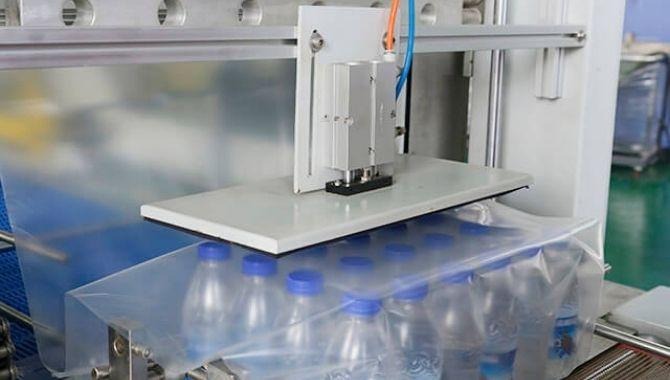
From the outside, an automatic plastic wrapping machine looks almost boring: a platform, a mast, a roll of film. Press a button and a pallet emerges cocooned in a tight, even spiral of stretch film. The apparent simplicity hides some clever engineering — here is what is actually happening during that minute-long cycle.
The Core Components
Every machine has the same essential anatomy. The turntable (or rotary arm) provides the relative rotation between pallet and film. The film carriage rides up and down a mast, controlling where film lands on the load. The pre-stretch unit — two rollers turning at different speeds — elongates the film before application. And the control panel orchestrates the whole cycle: rotation speed, carriage speed, wrap counts, and tension. An automatic plastic wrapping machine is essentially these four systems in precise coordination.
The Wrap Cycle, Step by Step
The operator places the pallet and starts the cycle. The film tail is attached — automatically on better machines — and rotation begins. The carriage climbs the mast, laying overlapping bands of pre-stretched film up the load, then descends to reinforce the bottom. Top and bottom wraps get extra revolutions because those are where loads fail. Finally the film is wiped down or heat-sealed, the rotation stops, and the cycle ends. Total elapsed time: typically 60 to 90 seconds for a standard pallet.
Pre-Stretch: The Clever Bit
- Two powered rollers grip the film and turn at different speeds, stretching it 200-300%.
- Pre-stretched film is thinner but stronger per unit weight — more pallets per roll.
- Consistent stretch means consistent containment force on every load.
- This single mechanism is responsible for most of the film savings an automatic plastic wrapping machine delivers.
Containment Force and Load Types
Wrapping is not about using the most film; it is about applying the right containment force. Uniform, stable loads need moderate, even wraps. Irregular or crushable loads need gentler tension with more revolutions. Top-heavy pallets benefit from extra top wraps or a top sheet. Modern controls let operators store recipes for different load types — select the profile, press start, and the automatic plastic wrapping machine reproduces the ideal wrap every time.
Understanding the mechanism helps you specify the right machine — and when you are ready to compare models, looking at automatic plastic wrapping machine options side by side makes the differences in pre-stretch systems and controls easy to evaluate.
Turntable vs Rotary Arm: How the Mechanisms Differ
The two dominant designs solve the same problem differently. In a turntable machine, the pallet spins on a rotating platform while the film carriage travels vertically — simple, compact, and cost-effective for stable loads under about two tons. In a rotary arm machine, the pallet stays still while an arm carrying the film roll circles it at speed. The arm design handles loads that must not be spun: unstable stacks, very heavy pallets, or fragile goods. Throughput differs too — rotary arms generally cycle faster since they are not limited by how quickly a loaded turntable can safely rotate. Choosing between them for your automatic plastic wrapping machine comes down to load characteristics first and budget second.
Common Problems and Quick Fixes
- Film breaks repeatedly: usually excessive tension or a nicked roller — reduce pre-stretch slightly and inspect rollers.
- Wrinkled or uneven wrap: carriage speed mismatched to rotation — adjust the ratio until bands lie flat.
- Load toppling during wrap: too much speed for an unstable load — slow the cycle or switch to a rotary arm profile.
- Film tail not adhering: dirty clamp or worn wipe-down pad — clean or replace, a two-minute job on any automatic plastic wrapping machine.
How Wrapping Fits Into the Packaging Line
Wrapping is the final step in most packaging lines, which makes it the gatekeeper of shipping schedules. Upstream, cases are packed, sealed, and palletized; the wrapping machine’s job is to unitize all of that into a shippable load. Smart facilities integrate conveyors so pallets flow from palletizer through the automatic plastic wrapping machine to staging without forklift intervention. When specifying, think in terms of line balance: the wrapper should never be the slowest step. Size throughput with headroom for peak seasons, and the end of your line will hum instead of choke.
The Future: Smarter Wrapping Machines
Wrapping technology keeps evolving. IoT-connected machines now report film usage, cycle counts, and fault codes to supervisors’ dashboards, turning the humble wrapper into a data source. Automatic film-roll changing systems eliminate even the changeover downtime. And machine-learning-assisted tension control — already appearing in premium models — adapts wrap force to each load’s profile in real time. The trajectory is clear: the automatic plastic wrapping machine is becoming a connected, self-optimizing part of the smart warehouse rather than a standalone device. Buying with connectivity and upgrade paths in mind keeps your investment relevant as these capabilities become standard.
Maintenance in Plain Terms
These machines ask little: keep the rollers clean, check film threading, inspect the turntable chain or belt periodically, and keep spare film on hand. Most issues trace back to film loading errors or worn rollers — both fixed in minutes. Treat the machine to basic care and it will wrap tens of thousands of pallets without drama.