
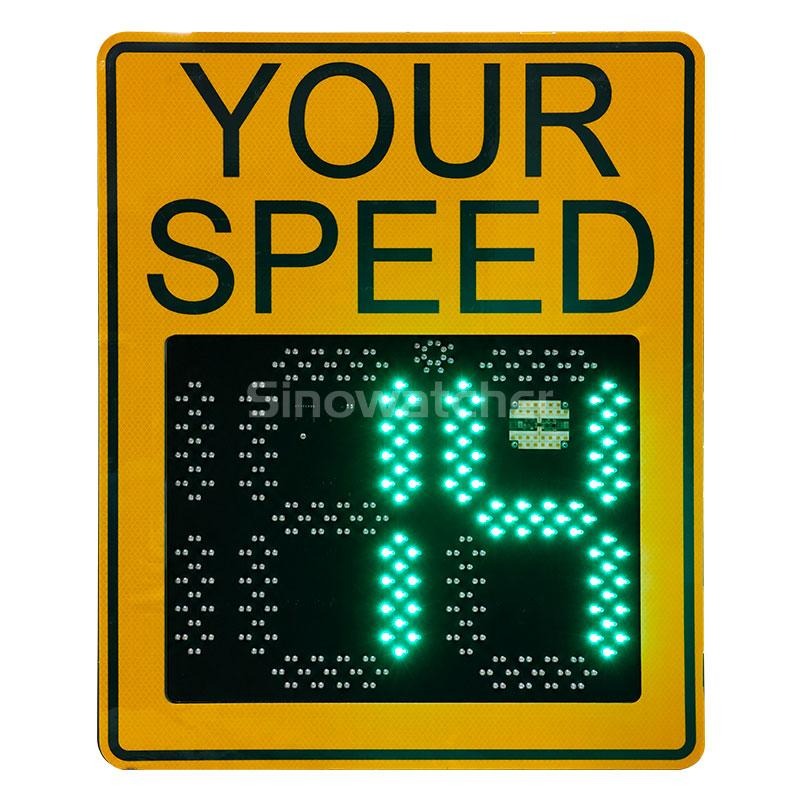
Your brain pays attention to numbers about you
There is a reason a speed feedback sign grabs you in a way a painted speed limit never does. Psychologists call it the self-reference effect: information that relates to you personally is processed faster and remembered longer. A static “30” on a metal plate is background scenery; a glowing display showing your speed — your number, right now — hijacks your attention because your brain treats it as personal information. That split-second of attention is the entire mechanism. Before you have time to rationalize, your foot is already easing off the pedal.
This is why speed feedback works on drivers who ignore everything else. The sign does not lecture or threaten. It simply holds up a mirror. Most drivers genuinely believe they were doing the limit — research on driver self-assessment consistently shows people underestimate their own speed. The display corrects that private fiction with a public fact, and the correction lands because it feels neutral. Nobody likes being told what to do by a machine, but everyone responds to accurate information about themselves.
The feeling of being watched
The second mechanism is social accountability. A speed feedback sign sits in public, and every driver knows the display is visible to pedestrians, neighbours, and the car behind. This triggers what researchers call the audience effect: people behave better when they believe they are being observed. The sign does not record your plate or issue a fine, yet drivers slow down as if it might — because the display makes their behaviour legible to everyone on the street.
This explains a curious finding from field studies: speed feedback signs often keep working for months after installation, long after the novelty should have worn off. Habituation is real — drivers do start noticing the sign less — but the social component does not fade in the same way. As long as the display is bright and accurate, the quiet pressure of being seen keeps speeds down. When signs lose their effect, it is usually because the display has dimmed, the radar has drifted, or the unit was placed where nobody can read it: maintenance failures, not psychology failures.
What the studies actually show
The evidence base for speed feedback is unusually consistent for traffic safety. Across dozens of studies of speed feedback in the US, UK, and Australia, the typical result is a reduction of 4 to 8 km/h (roughly 3 to 5 mph) in average speeds, with the biggest drops among the fastest drivers — exactly the group that causes the most danger. Some sites report 85th-percentile speeds falling by even more, which matters because crash risk rises steeply with speed.
The reductions also persist. Unlike police enforcement blitzes, where speeds creep back within days, a permanent speed feedback installation tends to hold its gains for years. One reason speed feedback keeps its gains is that the sign changes the social norm of the street: when every driver sees the display flashing at speeders, the collective sense of “how fast people drive here” resets downward. New drivers arriving on the street inherit the calmer norm without ever being told.
- Place the display where drivers must look — on the approach to a curve, a crossing, or a zone entry, not buried in visual clutter
- Keep the radar honest: a display that reads even slightly high destroys trust, and the effect with it
- Pair the sign with a painted limit on the road so the feedback has a reference point
- Keep it lit and legible; a dim or flickering display teaches drivers to ignore it
Why fines punish but feedback teaches
Compare the psychology of a speeding ticket with that of a speed feedback sign. A fine arrives weeks later, from a camera you never saw, for a moment you barely remember. Behavioural science is clear that delayed, uncertain punishment is a weak teacher. Feedback, by contrast, is immediate and certain: you see the number, you adjust, you watch the number fall. That tight loop is how humans actually learn — the same loop that makes video games engaging and fitness trackers effective.
This does not mean enforcement is useless. It means speed feedback handles the large middle of drivers — the well-meaning majority who drift over the limit without realising — while enforcement stays focused on the deliberate few. Cities that deploy speed feedback widely get more safety per dollar: the sign educates continuously for the cost of one installation, and police hours go where human judgement is truly needed.
Designing for the brain, not the brochure
If you take the psychology seriously, several design choices follow. Brightness should be automatic — a display that blinds at night or washes out at noon breaks the mirror. Digits should be large enough to read at decision distance, because feedback that arrives after the braking point is just decoration. And the display should show the driver’s actual speed rather than a generic warning; the personal number is the whole psychological payload.
The deeper lesson is that drivers are not rational calculators of risk, and treating them as such has limited returns. Another sign, another fine schedule, another awareness campaign — all assume the problem is information or deterrence. The speed feedback sign assumes something truer: that most speeding is inattention, and that a well-timed, personal, public nudge is enough to fix it. Your brain hits the brakes not because it fears the sign, but because the sign finally made it notice.