
Combining registered physiological measurements, advanced biosensing and AI-powered data analysis, Youhong Medical (J-Style) demonstrates how smart rings and screenless wearable devices are contributing to the next generation of connected digital health solutions.
DÜSSELDORF, Germany — The wearable health technology industry is entering a new phase in which devices are expected to do more than record basic physiological measurements. Advances in biosensor technology, artificial intelligence and connected software platforms are creating new opportunities to transform everyday health data into useful information about personal health patterns.
This changing landscape is among the developments highlighted at MEDICA 2026, where Youhong Medical (J-Style) is showcasing its latest wearable technologies, including JCRing smart rings, JCVital smart bands and integrated digital health solutions at Hall 7.1, Stand D41-1.
Through its expanding product portfolio, the company demonstrates how compact wearable devices can combine registered measurement functions with additional health-monitoring capabilities and AI-assisted analytical tools. Its approach reflects two important areas of industry development: improving physiological data collection and making the information generated by wearable devices more accessible and understandable.
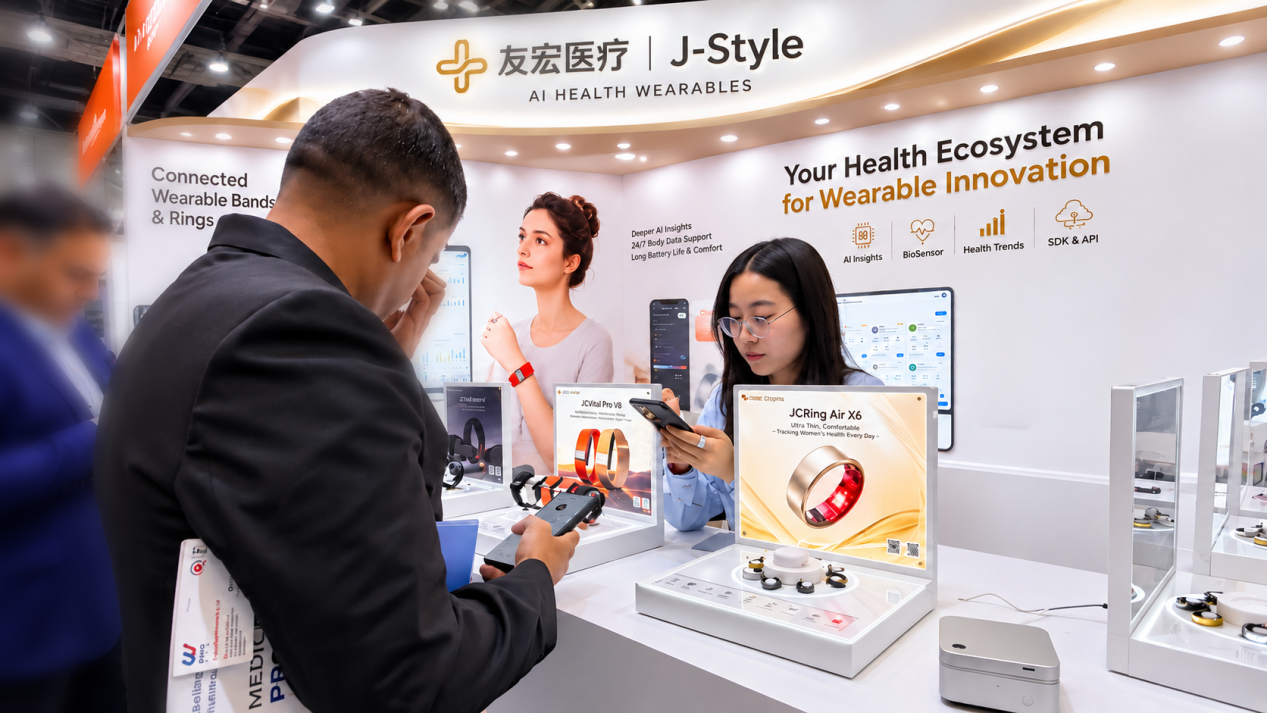
The Growing Connection Between Biosensors and Artificial Intelligence
Wearable technology has traditionally concentrated on measuring individual health indicators, including heart rate, blood oxygen saturation, sleep duration and daily physical activity. While these measurements provide useful information, understanding their relationship over time can offer a broader perspective on everyday health.
BioSensor technology plays an important role in this development. Optical sensors and motion-detection components allow wearable devices to collect physiological signals during daily activities and sleep. Advanced processing systems can then organize these signals into structured information for further analysis.
Artificial intelligence adds another layer to this process. AI-assisted algorithms can examine relationships between different measurements, identify recurring patterns and present information in a more accessible format.
For example, changes in sleep patterns, activity levels and heart rate variability may provide additional context when reviewed together rather than individually. Such analysis can help users observe changes in their daily routines and recovery-related indicators.
However, the usefulness of these applications depends on sensor accuracy, algorithm performance, appropriate validation and responsible interpretation. AI-generated health information should complement, rather than replace, professional medical assessment where required.
JCRing Med X3 Brings Registered Measurement Functions to Smart Rings
The JCRing Med X3 represents Youhong Medical’s approach to combining compact wearable design with specific registered physiological measurement capabilities.
Developed as a smart ring, the device incorporates adult blood oxygen saturation (SpO₂) and pulse-rate measurement functions that have received China Class II medical device registration from the National Medical Products Administration (NMPA).
This registration specifically covers the stated measurement functions in China. It should not be interpreted as European Union Medical Device Regulation (EU MDR) certification or approval for other medical applications.
In addition to its registered measurement capabilities, JCRing Med X3 offers several health-management features, including sleep monitoring, sleep apnea risk assessment and AI-assisted blood glucose risk assessment.
These additional functions are separate from the product’s registered medical indications. In particular, its AI-assisted blood glucose risk assessment does not directly measure glucose levels and cannot replace conventional glucose testing, laboratory investigations or clinical diagnosis.
The product illustrates how smart rings are developing beyond basic activity tracking. By incorporating selected physiological measurement functions alongside broader wellness-oriented applications, manufacturers are exploring new ways to make health-related technology more convenient for everyday use.
Its compact form factor also reflects the growing interest in wearable devices designed for continuous, comfortable use without requiring users to interact frequently with a screen.
JCVital Pro V8 Explores a More Intelligent Approach to Daily Health Monitoring
Another product featured in Youhong Medical’s wearable portfolio is the JCVital Pro V8, a screenless smart band developed around continuous daily wear and connected health tracking.
Rather than relying on a traditional display, the device works with a companion application to present collected information and help users review their health-related patterns.
Its monitoring capabilities include sleep, heart rate, heart rate variability (HRV), blood oxygen, physical activity, stress and recovery-related indicators.
One of the distinctive elements of the JCVital experience is its Fuel concept. Through visual representations, the platform aims to simplify the presentation of different health and recovery indicators, making information easier for users to understand.
The device also connects with AI Health Insights, which explores relationships among different data points to provide additional context around sleep, activity and recovery.
Users can access weekly and monthly reports to review historical information and identify changes across longer periods. This creates an experience that goes beyond displaying individual readings and encourages a more comprehensive understanding of everyday health trends.
The development of screenless wearables also represents an interesting direction for the industry. By reducing dependence on traditional screens, these products can prioritize comfort, simplicity and background data collection while allowing users to access detailed information through connected applications.
Developing an Integrated Ecosystem for Connected Digital Health
The future of wearable health technology will depend increasingly on how individual devices connect with wider digital platforms.
Instead of treating smart rings and bands as standalone products, manufacturers are developing interconnected systems that combine hardware, biosensors, mobile applications, data analytics and cloud-based services.
Youhong Medical’s broader JCVital strategy follows this direction through its Body, Bio and AI initiatives. These areas bring together different aspects of personal health monitoring, physiological data collection and intelligent information processing.
The company’s ecosystem includes smart rings, smart bands, body-composition monitoring solutions and related digital health services.
Through the JCVital Pro application and associated digital platforms, users can access health data visualization, historical records and periodic reports. Connected wearable devices serve as the data collection layer, while software and analytical technologies help organize and present the resulting information.
This integrated approach reflects an important change in the wearable technology market. Competitive advantages are no longer determined exclusively by hardware specifications or the number of sensors included in a device. Software capabilities, data interpretation, application usability and connectivity are becoming equally important parts of the overall product experience.
As connected health platforms expand, privacy protection, information security and transparent data management will also remain essential. Companies developing these ecosystems must consider how personal information is collected, processed, stored and shared across connected services.
One-Stop Digital Health Technology Through Hardware, Software and AI Integration
Developing a complete wearable health solution requires expertise across several technical disciplines. Sensor integration alone is not sufficient to create a reliable and scalable connected product.
Hardware engineering, biosensing, firmware development, mobile software, data processing and cloud infrastructure must work together to support the complete user experience.
Youhong Medical brings these capabilities together through its integrated digital health technology offering. Its development areas include wearable hardware engineering, BioSensor technology, firmware and software development, mobile applications, AI-assisted data analysis and cloud-connected digital health services.
The company also provides Software Development Kit (SDK) and Application Programming Interface (API) integration capabilities. These technologies can support connections between wearable products, third-party applications and external digital health platforms, depending on individual product specifications and project requirements.
This service model is designed to support organizations looking for more than an individual wearable device. Healthcare technology providers, international brands and digital health businesses may require customized hardware, compatible software environments and connected data services to develop their own solutions.
By bringing these elements together, Youhong Medical aims to provide one-stop digital health solutions covering physiological data acquisition, intelligent analysis, application development and connected technology services.
The integrated model also offers flexibility for different business requirements, allowing partners to explore wearable technology applications through a combination of hardware products, software capabilities and digital infrastructure.
MEDICA 2026 Highlights the Changing Direction of Wearable Health Technology
The technologies presented by Youhong Medical at MEDICA 2026 reflect several important trends influencing the development of connected health products.
First, wearable devices are becoming increasingly compact while incorporating more sophisticated sensing capabilities. Smart rings demonstrate how selected physiological measurements can be integrated into small form factors designed for everyday use.
Second, AI-assisted analytics are creating new possibilities for interpreting the information collected by wearable devices. Rather than presenting users with disconnected numbers, digital platforms are exploring ways to organize multiple indicators into broader health-related insights.
Third, the industry is moving toward connected ecosystems that combine wearable hardware, applications, software integration and cloud-based services. This development creates opportunities for technology providers to deliver more comprehensive digital health experiences.
JCRing Med X3 demonstrates the integration of registered blood oxygen and pulse-rate measurement functions within a smart ring, while JCVital Pro V8 focuses on screenless daily monitoring and AI-assisted health insights.
Together, these products illustrate how different wearable formats can serve complementary purposes within a wider digital health environment.
As adoption increases, long-term industry progress will depend on maintaining appropriate regulatory compliance, validating measurement performance, protecting personal information and clearly communicating the limitations of AI-assisted health features.
About Youhong Medical (J-Style)
Youhong Medical (J-Style) specializes in smart wearable health technology, biosensing solutions and integrated digital health services. Its product portfolio includes JCRing smart rings, JCVital smart bands and other connected health-monitoring technologies.
The company combines wearable hardware development, BioSensor technology, firmware and software engineering, AI-assisted health analysis, mobile applications and cloud-based services to support the development of integrated digital health solutions.
Its capabilities also include SDK and API integration for connecting wearable devices with external applications and digital platforms. Through this combination of technologies, Youhong Medical aims to serve international partners seeking comprehensive wearable health products and customized digital health solutions.
By connecting physiological data collection with intelligent analysis and connected software services, the company continues to explore opportunities in the evolving global wearable health technology market.
Email: info@jointcorp.com