
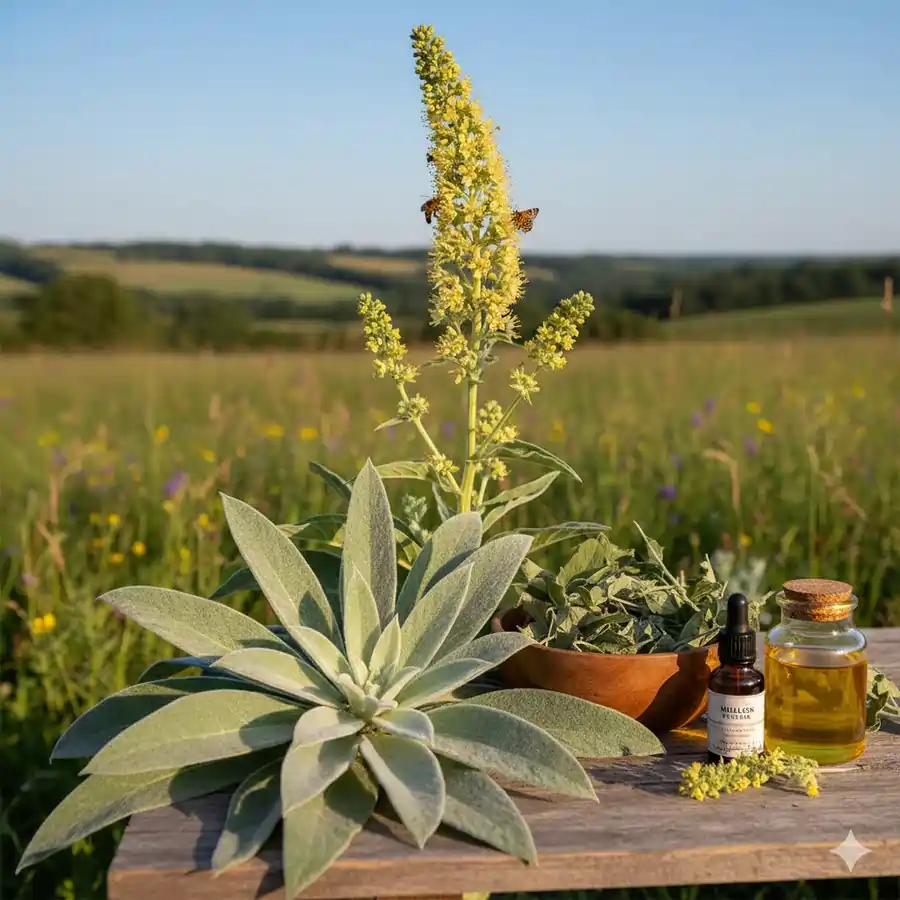
In this guide, What is mullein means one thing: an evidence-based look at the mullein plant (most often Verbascum thapsus) and the ways people use it today. You’ll learn what mullein is, which parts matter, what it contains, what higher-quality sources say, and how to think about safety without exaggerated claims.
What is mullein?
Mullein is a common name for several Verbascum species, most often common mullein (Verbascum thapsus). It’s a biennial plant known for a rosette of soft, fuzzy leaves in year one and a tall flowering stalk in year two.
You’ll see mullein sold as:
- Dried leaf (for tea or tinctures)
- Dried flower (often for teas and infused oils)
- Extracts (tinctures, glycerites, capsules)
In formal herbal regulation, mullein is discussed as a herbal substance with defined quality standards. For example, the European Medicines Agency (EMA) monograph focuses on mullein flower (Verbasci flos) and frames its use as traditional (experience-based), not as a modern “proven cure.”
Which mullein species and plant parts are used?
Species you’ll see in references
Regulatory and pharmacopoeial documents commonly reference:
- Verbascum thapsus
- Verbascum densiflorum (sometimes historically listed as V. thapsiforme)
- Verbascum phlomoides
The EMA assessment report explicitly defines “mullein flower” as flowers of those species and links the herbal substance to pharmacopoeial standards.
Parts: leaf vs flower (why it matters)
- Flower (Verbasci flos): the part most often covered by formal monographs for throat/cough comfort in the “traditional use” category.
- Leaf: widely used in popular wellness (especially tea), and heavily discussed in ethnobotany and reviews, but not always the same regulatory focus as the flower.
What compounds does mullein contain?
Mullein contains multiple classes of plant compounds that researchers often link to soothing or protective properties in lab settings:
- Polysaccharides / mucilage (often discussed as “demulcent” in herbal literature)
- Flavonoids (e.g., luteolin, apigenin derivatives)
- Iridoid glycosides (e.g., aucubin-related compounds in Verbascum species)
- Saponins
- Phenylethanoid glycosides (commonly discussed in Verbascum research)
The EMA assessment report lists specific flavonoids identified in Verbascum flowers and provides compositional context used for monograph decisions.
A widely cited scientific review also summarizes major constituent classes reported for V. thapsus.
Why this matters: these compounds can support plausible mechanisms (like soothing irritated tissue or influencing inflammation pathways), but mechanism ≠ proven clinical outcome.
What is mullein good for?
People usually ask this question with respiratory comfort in mind. In evidence terms, mullein is best described as traditionally used for relief of throat irritation and dry cough symptoms during colds, with limited direct human clinical evidence for mullein alone.
What high-quality monographs say (strongest “real-world” signal)
The EMA’s herbal monograph states mullein flower is a traditional herbal medicinal product used to relieve symptoms of sore throat associated with dry cough and cold, and it emphasizes “traditional use” rather than “well-established use.”
It also includes safety-style guidance typical of regulated monographs (age limits, when to seek care, pregnancy/lactation cautions).
What Commission E (Germany) historically recognized
German Commission E monographs (as republished by the American Botanical Council) include mullein flower in the context of catarrh-related respiratory use (monograph-level, not a modern clinical trial claim).
What research reviews add (context, not a guarantee)
A 2021 review of Verbascum species summarizes broad traditional uses and discusses anti-inflammatory potential of phytochemicals, but this is still not the same as strong clinical proof in humans.
How strong is the clinical evidence?
Respiratory comfort: mostly traditional + indirect evidence
- Best-supported “use case” framing: symptom relief (soothing throat, dry cough discomfort), based on long-standing use recognized by EMA.
- Clinical trial evidence for mullein alone: limited in major databases compared with many other botanicals (most evidence is preclinical or combination formulas).
Practical interpretation: mullein sits in the “reasonable traditional option for mild symptoms” bucket, not in the “clinically proven treatment” bucket.
Ear pain studies: interesting, but not mullein-only
One randomized clinical trial compared a herbal ear drop combination (garlic + mullein + calendula + St John’s wort in olive oil) versus anesthetic ear drops for ear pain with acute otitis media, and found similar pain improvement over the study period (combination product, not mullein by itself). DOI: 10.1001/archpedi.155.7.796
Important: ear infections can become serious. This is not a DIY area.
Statistical snapshot: why herbs like mullein trend
Stats block 1 — supplement use is common (U.S.)
During 2017–2018, 57.6% of U.S. adults reported using any dietary supplement in the past 30 days (NHANES).
Stats block 2 — herb/supplement use is a large minority (U.S.)
An analysis of NHIS data estimated 40.6 million U.S. adults reported herb and supplement use in 2012, with prevalence around 17.9% in 2007 and 2012.
How do people typically use mullein?
Below is a practical overview (not medical advice). Follow product labels and consider clinician guidance, especially if symptoms are persistent.
| Form | What it is | Typical goal people have | Evidence level |
|---|---|---|---|
| Tea/infusion (leaf or flower) | Dried herb steeped in hot water | Throat comfort; “soothing” feel | Traditional + limited clinical |
| Tincture/extract | Alcohol/water extract | Convenience; consistent dosing | Depends on product; limited human data |
| Infused oil (flower) | Flowers infused in oil (used externally in combo products) | Ear comfort (common in tradition) | Evidence mostly combo products |
A key preparation detail: strain well
Mullein leaf is covered with fine hairs (trichomes). Herbal references often advise straining tea thoroughly to reduce throat irritation from these hairs.
What safety cautions matter most?
When to be cautious or avoid
EMA monograph-style cautions for mullein flower include:
- Avoid if you have hypersensitivity/allergy to the herbal substance.
- Not recommended in pregnancy or breastfeeding due to insufficient safety data.
- Not recommended for children under 12 in the EMA traditional-use monograph (lack of adequate data).
- Seek medical help if symptoms include shortness of breath, fever, or purulent sputum (this matters for respiratory symptoms).
Skin reactions can happen
Case reports exist for contact dermatitis associated with Verbascum thapsus. DOI: 10.1111/cod.12710
Checklist: choosing mullein with less risk
- The label lists the species (e.g., Verbascum thapsus) and plant part (leaf vs flower).
- The product states quality controls (e.g., batch testing, contaminants).
- For tea, you can strain very well (fine mesh/cloth) to reduce irritation risk from hairs.
- You avoid use during pregnancy/lactation unless a clinician approves.
- You don’t use herbs to delay care when red flags appear (fever, breathing trouble, worsening symptoms).
What is mullein | FAQ
1) What is mullein?
Mullein is a plant in the Verbascum genus, most often Verbascum thapsus. People commonly use its leaf or flower in teas and extracts.
2) Is mullein proven to treat coughs or colds?
No. The best-supported framing is traditional use for symptom relief, especially sore throat with dry cough during colds, as described by EMA for mullein flower.
3) What part of mullein is used most often?
Both leaf and flower are used. Formal European monographs focus on mullein flower (Verbasci flos) for throat/dry cough symptom relief.
4) Can mullein tea irritate the throat?
It can if fine leaf hairs remain in the tea. Many herbal references recommend thorough straining.
5) Is mullein safe during pregnancy?
Safety is not established. The EMA monograph does not recommend use during pregnancy and lactation due to insufficient data.
6) What evidence exists for mullein in ear discomfort?
A clinical trial found an herbal ear drop combination including mullein was comparable to anesthetic ear drops for pain relief in acute otitis media. This does not prove mullein alone works. DOI: 10.1001/archpedi.155.7.796
Glossary (quick terms)
- Verbascum thapsus — common mullein species often used in products.
- Verbasci flos — pharmacopoeial term for mullein flower as a herbal substance.
- HMPC (EMA) — committee that evaluates herbal monographs in the EU.
- European Pharmacopoeia (Ph. Eur.) — quality standards referenced for herbal substances.
- Flavonoids — plant compounds often discussed for antioxidant/anti-inflammatory potential.
- Iridoid glycosides — a class of compounds reported in Verbascum species.
- Saponins — compounds sometimes discussed in relation to expectorant-like properties (mostly mechanistic).
- Contact dermatitis — skin inflammation from contact exposure; reported in case literature for V. thapsus.
What is mullein | Conclusion
Mullein is best viewed as a traditional, symptom-support herb, especially for throat and dry cough discomfort, with limited direct human evidence. If you want to try it, choose a clearly labeled product, strain tea carefully, and use it as part of a sensible self-care plan—not a substitute for medical care.
Sources
- European Medicines Agency (EMA), HMPC. European Union herbal monograph on Verbascum thapsus L., V. densiflorum Bertol., V. phlomoides L., flos (2018). URL: ema.europa.eu (document: “final-european-union-herbal-monograph…verbascum…flos_en.pdf”).
- EMA, HMPC. Assessment report on Verbascum thapsus L., V. densiflorum Bertol., V. phlomoides L., flos (2018). URL: ema.europa.eu (document: “final-assessment-report…verbascum…flos_en.pdf”).
- American Botanical Council (ABC). Mullein flower — Commission E monograph (republished resource). URL: herbalgram.org.
- Sarrell EM, et al. Efficacy of naturopathic extracts in ear pain with acute otitis media (2001). DOI: 10.1001/archpedi.155.7.796. URL: pubmed.ncbi.nlm.nih.gov/11434846/.
- Flores Echaiz CF, et al. Simultaneous Contact Dermatitis Caused by Asteraceae and Verbascum thapsus (2017). DOI: 10.1111/cod.12710. URL: pubmed.ncbi.nlm.nih.gov/28386973/.
- Mishra S, et al. NCHS/CDC. Dietary Supplement Use Among Adults (NHANES 2017–2018; Data Brief 399, 2021). URL: cdc.gov/nchs/products/databriefs/db399.htm.
- Wu CH, et al. Trend and Pattern of Herb and Supplement Use in the United States (NHIS analysis, 2014). URL: pmc.ncbi.nlm.nih.gov/articles/PMC4276694/.
- Turker AU, Camper ND. Biological activity of common mullein (2002). URL: sciencedirect.com (S0378874102001861).
- ABC Herbalgram. Herb Profile: Mullein (notes on traditional preparation/straining). URL: herbalgram.org (issue 142).