
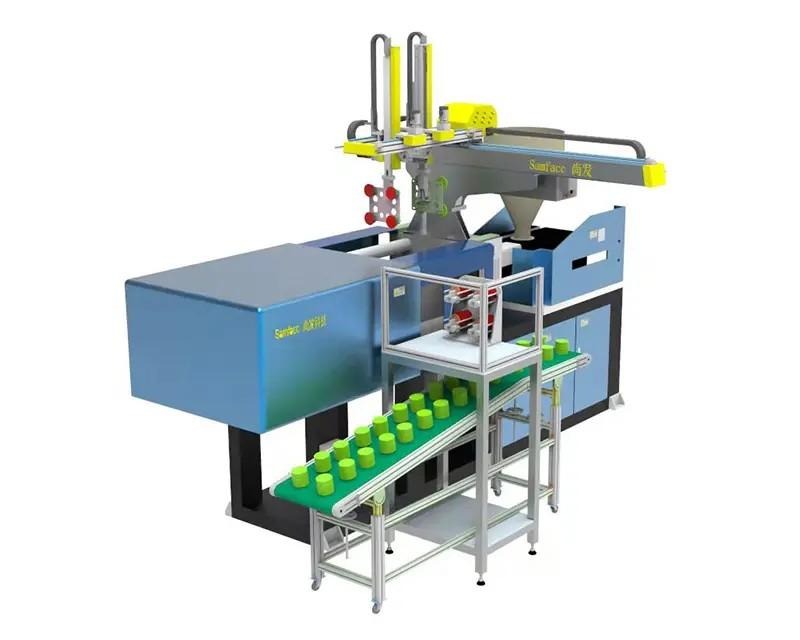
3-Axis or 5-Axis: What the Extra Axes Buy
The first fork is axis count — really a question about what the label must do inside the mould. A 3-axis iml robot moves linearly: in and out of the mould area, up and down, and the strip stroke that places the label or pulls the part. For straightforward top-entry placements — a label laid flat into a tub mould — three axes are plenty, and the simplicity means fewer things to wear, align, and maintain across a decade of shifts.
Five-axis machines add wrist rotation, letting the pick head tilt and turn the label on the way in. That matters when the label wraps a curved wall, sits on two container faces, or enters a mould where the approach is not a straight vertical drop. The extra axes cost more and need more careful programming — do not buy them speculatively. Choose the iml robot your label geometry actually demands. A good supplier studies your part drawing and tells you honestly; a bad one sells five axes for a flat label.
Payload, Reach, and the Mould You’ve Got
Payload on an iml robot sounds modest — labels weigh grams — but the real number is the end-of-arm tooling plus the part, if the robot also extracts. A pick head with vacuum cups, static charging, and sensors can weigh several kilos, and at these accelerations every gram multiplies wrist forces. Undersize it and you get vibration, placement drift, premature wear; oversize and you pay for unused capacity while slowing the cycle. Size to the tooling, not the label.
Reach is the other half. The traverse stroke must clear your mould’s width with margin; the vertical stroke must reach the deepest cavity plus the magazine’s stack height. Bring mould dimensions — daylight, mould height, tie-bar spacing — to the quotation meeting, not just part weight. An iml robot that cannot physically span your press is an expensive lesson, and the most common sizing mistake: buyers spec the robot for the part and forget the machine it works inside.
Take-Out Time: The Spec That Moves the Needle
Ask for the dry cycle time — how fast the iml robot completes a full place-and-retract with no mould in the way. Good machines run well under two seconds; the best approach one. But the brochure number is not the working number. What counts is overlapped time: how much motion hides inside the mould’s natural open phase for ejection versus how long the mould waits. A well-integrated cell buries nearly all handling in time the mould was open anyway.
This is where controls earn their keep. Robot and injection moulding machine must handshake precisely — mould-open signal, enter permission, placement confirm, clear signal, mould close. Sloppy handshaking adds tenths of a second per cycle; over millions of cycles, tenths are money. When you evaluate an iml robot, ask for the timing diagram of your cycle, not just top speed. The winner never makes the mould wait.
Integration With the Injection Moulding Machine
Robot and press are one system, and their interface decides how painless that is. Most modern setups speak Euromap — the standard protocol letting the iml robot and the injection moulding machine exchange signals, safety interlocks, and fault states without custom wiring. Confirm your press supports it, and which version; mismatched expectations here cause the industry’s longest commissioning delays.
Think mechanically, too. The robot typically mounts on the fixed platen or a separate frame beside the press — check floor space and guarding. The mould needs designing or modifying for in-mould labelling: label seating, static or vacuum hold, pick-head clearance. Involve the mould maker early — if the iml robot meets a mould never designed for it, the project stalls. And plan utilities: compressed air for vacuum and blow-off, plus power, routed cleanly.
The Label-Handling Details Nobody Brochures
Two iml robot models with identical axis and payload specs can differ enormously in label handling — this is where experienced buyers focus. How does the magazine beat static? Is there double-pick detection, and on trigger does the cell stop or skip? How long is label changeover, and does it need tools? Does the magazine hold a full shift of labels, or get refilled hourly? These answers decide whether the cell runs unattended.
Ask about label tolerances, too. Pre-printed film varies — cutting tolerance, curl, stiffness between batches — and a head tuned for one batch can fight the next. Good systems build compliance into the gripper with adaptive sensing; brittle ones need retuning every delivery. When comparing quotes, put the iml robot’s label-handling features side by side before prices — the cheaper machine that stops twice a shift is the expensive one.
After-Sales: The Quote Line That Matters Most
Purchase price is the beginning of cost, not the end. Who services the machine in your region? What is the contracted response time? Which spares sit locally versus shipping from the factory? A failed vacuum generator should be a next-day fix, not a six-week wait from overseas. Training matters equally: your technicians must program placements, change labels, and diagnose faults without phoning the supplier each time. Get these answers in writing:
- Who is the local service engineer, and the contracted response time?
- Which wear parts are stocked domestically, and at what prices?
- What training is included — on your machine, with your labels?
- What does the warranty cover: the full cell, or just the arm?
Finally, demand references — not logos on a slide, but two customers running the same machine class who will take a call. Ask about commissioning time, real versus quoted cycle times, and supplier behaviour when something broke. An iml robot is a ten-year relationship with its builder; references tell you what those years feel like. Buy the support network as seriously as the hardware, and the machine still earns when the invoice is a distant memory.