
The market is flooded with pore vacuums that all look identical in photos: a white wand, a few plastic heads, big suction claims. Under the hood they differ enormously, and the wrong choice either does nothing or leaves you with red marks. This guide cuts through the marketing so you buy a vacuum blackhead remover that actually performs.
Suction Power: The Number That Matters
Look for suction specified in kPa, not vague superlatives. Effective home devices range roughly from 50 to 65 kPa at maximum, but the maximum is less important than adjustability. You want at least three distinct levels: low for sensitive cheeks, medium for the forehead, high for the nose and chin. Single-speed devices force a compromise everywhere, which is why they underperform on stubborn blackheads and overdo it on delicate areas. Stepped control is the single most important feature on the spec sheet of any vacuum blackhead remover worth buying.
Head Selection and Build Quality
Count the heads and inspect their rims. You want a small precision head for the nose, a medium head for general zones, and ideally an exfoliating or microdermabrasion head for texture. Rims should be smooth and slightly flexible to maintain a seal without digging in; cheap hard-plastic rims leak air and irritate skin. Heads must detach easily for washing, because a vacuum blackhead remover with un-cleanable heads becomes a bacteria farm within weeks. Spare heads in the box are a plus, since they wear and need replacing.
Hot and Cold Therapy Modes
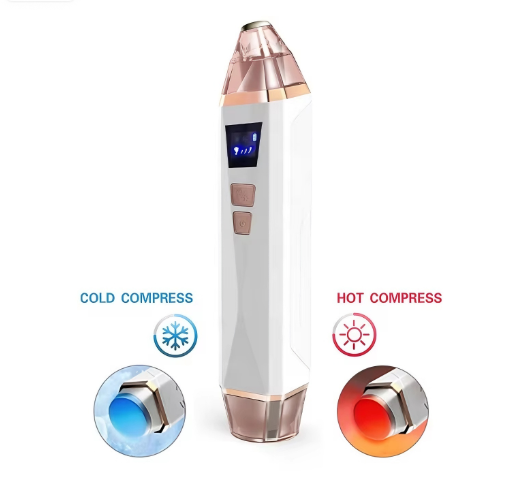
Premium models add thermal modes for good reason. A hot compress setting, usually around 40 to 45 degrees, softens sebum before extraction so lower suction does the job, reducing redness. A cold mode afterward constricts pores and calms the skin, finishing the session the way a facialist would. These are not gimmicks; they replicate the professional facial sequence of open, extract, close. If your budget stretches, thermal modes are where to spend it, because they improve both comfort and results more than any suction upgrade.
Display, Battery, and Usability
An LCD or LED display showing suction level and battery status sounds minor until you are mid-session guessing which setting you are on. USB-C rechargeable batteries with at least 60 to 90 minutes of runtime mean the device is ready when you are, not tethered to a charger. Waterproofing to IPX6 or better lets you rinse the whole unit and use it safely after a shower, when pores are most receptive. Ergonomics count too: a vacuum blackhead remover should sit comfortably in one hand with the power button reachable without shifting grip, since you will operate it by feel while watching the mirror.
What to Skip
Ignore WiFi cameras unless you genuinely enjoy inspecting your pores on a phone screen; they add cost without improving extraction. Ignore inflated suction numbers without kPa units. And be skeptical of any vacuum blackhead remover listing that shows dramatic before-and-after photos but no specifications: real performance is measured in kilopascals and head design, not Photoshop.
Price Tiers and What They Buy
Budget devices under twenty dollars typically offer two or three speeds, basic heads, and no thermal modes; fine for trying the concept. Mid-range models add stepped suction, better seals, LCD displays, and hot/cold functions, the sweet spot for regular users. Premium units differentiate on build quality, battery life, and waterproofing rather than raw suction, since physics caps useful suction well before marketing does. For most buyers, the mid-range vacuum blackhead remover is the rational choice: all the features that change outcomes, none that only change the price.
Quick Decision Framework
- Oily, congested nose and chin: prioritize max suction 60+ kPa and a precision head.
- Sensitive or thin skin: prioritize 4+ gentle low steps and soft-seal heads.
- Want the facial experience: get hot/cold modes and an LCD display.
- On a budget: a solid 3-speed device with washable heads beats a feature-stuffed weak one.
Buy for the suction control and the seal, and your vacuum blackhead remover will still be earning its shelf space years from now.
Red Flags in Product Listings
Learn to spot the listings to avoid. No kPa rating anywhere is the biggest red flag; honest manufacturers state suction in kilopascals because it is the only comparable metric. Stock photos showing the device but never the heads suggest the heads are an afterthought. Reviews mentioning broken units within weeks point to weak build quality, while reviews mentioning red marks usually point to single-speed suction with no low setting. Be wary of bundles advertising ten or twelve heads; beyond four or five genuinely different shapes, extras are filler. And treat any vacuum blackhead remover promising permanent pore shrinkage as dishonest, since no device changes pore anatomy. The trustworthy listings read almost boring: specifications, materials, warranty terms. Boring is good.
Check the warranty and returns policy before ordering. A one-year warranty signals the manufacturer expects the device to last; a thirty-day returns window lets you test the seal and suction on your own skin risk-free. These policies cost the seller money, which is exactly why their presence is a credibility signal.