
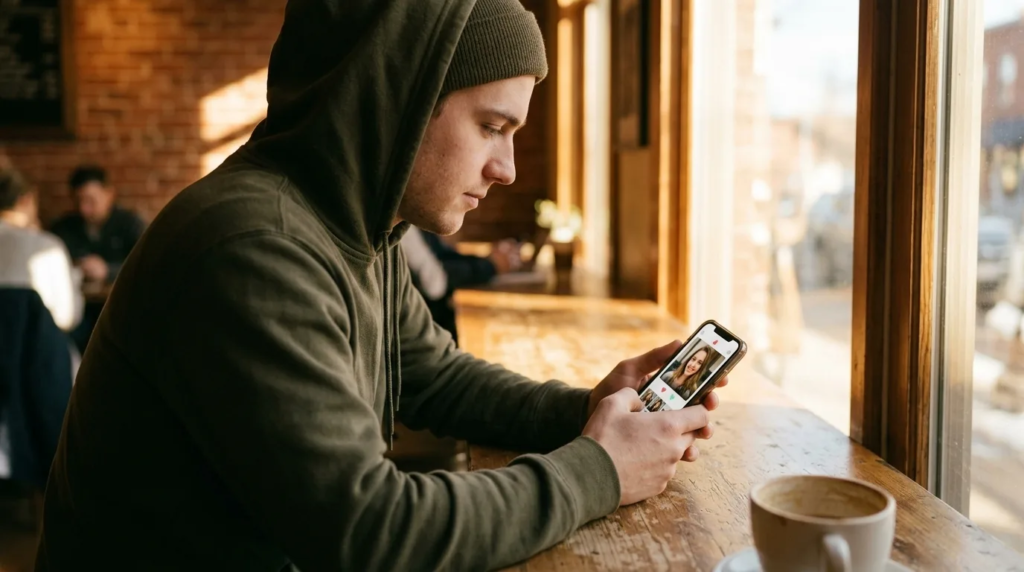
The average man on Tinder has a match rate of 0.6%. That means swiping right on 1,000 profiles gets you roughly 6 responses. For most people, that number feels about right, and they assume it is just how online dating works.
It is not. The math is bad because most profiles have bad photos, and bad photos on a visual-first platform kill your chances before the conversation starts.
The photo problem nobody talks about honestly
Photo quality is the single biggest factor in dating profile success, according to Statista’s 2024 dating app market analysis. Not bio cleverness. Not prompt answers. Photos, specifically photos that look like you had a reason to be photographed.
The data from Cloudwards backs this up: professional photos increase match rates by 49%. That is not a minor edge. That is roughly doubling your results by changing one variable.
The problem is access. Hiring a photographer costs $150 to $400, requires planning, and still depends on whether the final images feel natural. Most people give up after one mediocre shoot and go back to iPhone selfies. That is where AI Tinder photos have changed the practical math. The technology has gotten good enough that the results are hard to distinguish from real photos, and the workflow takes an afternoon rather than a scheduled shoot.
What AI photo tools actually do
The process is straightforward. You upload 10 to 20 existing photos of yourself, ideally with varied angles and decent lighting. The AI trains on your likeness and generates new images of you in different settings: coffee shops, outdoor locations, candid-style shots, cleaner headshots.
The output is not fake in the way that matters. You still look like you. The backgrounds and framing are just better than what your phone camera captures at arm’s length in your apartment.
Results vary depending on input quality. Blurry training photos produce blurry outputs. Photos where your face is partially obscured generate inconsistent results. The tools that explain this upfront tend to produce better final images.
Why this matters on Tinder specifically
Tinder uses an ELO-like scoring system that responds to early swipe behavior. If your first wave of right-swipes generates low match rates, the algorithm reduces your visibility to higher-rated profiles. Photos that perform well in early interactions set off a compound effect.
Independent testing by TruShot found that AI photo tools boosted match rates by around 20% on average. The gains were larger for users who started with weaker existing photos, which is most people. Someone already getting good results saw modest improvement. Someone with only selfies saw their numbers roughly double.
The specific shots that perform best are one clear headshot looking directly at camera, one activity shot suggesting a life outside your apartment, and one social photo where you appear at ease with others. AI tools make all three achievable without organizing a shoot.
What to look for in an AI photo generator
Not all tools produce the same results. Tools that ask for 15 to 25 photos across different angles and lighting generate more consistent faces than those that work from 5 to 10 photos. Check output resolution before committing: dating apps compress images on upload, so you want exports at 2000px or higher before any compression happens.
Style variety matters more than volume. The goal is 3 to 5 distinct photos for your profile, not 40 variations of the same shot. Tools that generate themed sets, such as headshot, lifestyle, and outdoor, are more practically useful.
Also check sample outputs before paying. Some tools produce images that look clearly synthetic: too sharp, skin texture like a video game character, lighting that does not match the scene. If you see that in their examples, move on.
Getting results across multiple platforms
Tinder is not the only app where photo quality matters. Hinge’s data shows that verified profiles are 56% more likely to receive matches. Bumble has similar patterns. If you are optimizing for one platform, you are leaving results on the table.
AI-generated photos have a practical edge over a one-off shoot here: you can tailor the output. Tinder favors confident direct-camera shots. Hinge performs better with context photos showing a hobby or location. Bumble’s user base responds to slightly more casual framing. Generating a few dozen options and selecting the right ones per platform takes an afternoon.
The part people skip
Once you have better photos, the next bottleneck is usually the rest of the profile. Good dating profile picture tips consistently point to the relationship between photos and text. Your first photo should create a question in the viewer’s mind. Your bio answers those questions selectively, not completely.
Profiles that perform well long-term are ones where the photos and the text describe the same person. AI photos can look excellent and still produce poor results if the bio does not match their energy.
If your current photos are selfies or group shots where you are not clearly identifiable, AI photo tools will improve your numbers. The 0.6% average match rate is not a ceiling. It is what happens when most people upload the first photos they have available.